
I have been able to read carefully, as well as listen to some interviews, to Professor Pablo Alarcón Peña, Director of the Graduate School of Law of the Universidad de Especialidades Espíritu Santo (UEES), regarding the Culture of Legality. A campaign, so to speak, that he has undertaken so that, from civism and academia, various actors can join in the recovery of ethics in public administration.
Thus, I believe that it is necessary that from our different locations and occupations we generate debate on the points that affect the public administration today and, for this occasion, the critical knot that I propose is that of legislation. A knot that is not necessarily enclosed to the National Assembly, but mainly in it, since it is from that function of the State that we citizens receive the laws that are going to be of daily and mandatory application in different aspects of our lives.
Therefore, the first issue to be criticized is not, in fact, the numerical composition of the National Assembly, since the problem does not lie in how many are, but in who they are. And, far from this being a proposal for the «elitization» of the legislature, it is necessary that the debate focuses on the type of person we vote for in the national parliament. In the last few weeks we have seen how former assembly members -whose presumption of innocence is respected- have been questioned for their -apparent- problematic social relationships and their -perhaps- peculiar lifestyles, which should make us reflect on the quality of candidates that political organizations postulate and that, as voters, offer us to vote for them.
I must, then, acknowledge a first step that the Constitutional Court has allowed by issuing the opinion 2-22-RC/23, with which the National Assembly is processing the constitutional amendment project of initiative of Assemblywoman Sofia Sanchez. In it, it is proposed that anyone who wants to run for Assembly must prove, first and foremost, the following, notorious probity, In addition, you must also provide proof of one of the following options: (i) experience, (ii) training or (iii) education, Obviously, in matters that are proper to the parliamentary activity. Thus, this is a proposal that should have the support of all citizens, as it tends to raise the level of the Ecuadorian parliamentarian; and, although it is not the solution to the problems that inevitably arise from political relations, it will help the citizen to have a more critical exercise of the person who is a candidate.
Raising the level of the quality of assembly members can lead to raising the level of legislative products. I reiterate, this is not a campaign of «elitization» of the parliament, since its purpose is not to propose that all legislators be lawyers, political scientists or scholars of Social Sciences; nor is it intended to ignore the eminently political nature of parliamentary activity. Its ultimate aim is to ensure that the legislature, with a better level, complies and enforces the maxim of Article 84 of the Constitution, that is, to legislate by formally and materially adapting the content of the laws to the Constitution, The laws of the Republic of Panama, observing the provisions of article 424 of the constitutional text, that is, that laws must be in conformity with the constitutional provisions, otherwise they will be legally ineffective..
One of the main problems that exists in the legislature is that its members on several occasions proceed with legislative actions that disdain their good training or preparation for the position they hold, perhaps motivated solely by party obedience and discipline, perhaps for reasons that are known only in the corridors of parliament. In this way, there are approvals of legal texts that are openly unconstitutional and that, many times, are not observed in the presidential veto. We have also seen motions of figures not contemplated in the law and much less in the Constitution, such as «the denial and filing of the partial objection» presented in the 899th session of the National Assembly regarding the «Organic Law to Confront the Internal Armed Conflict, the Social and Economic Crisis» which resulted, among other things, in the increase of the Value Added Tax (VAT). Or also a deformed and abusive exercise of political control over entities that are clearly not obliged to attend the appearances of the National Assembly, such as: National Police, Armed Forces, Decentralized Autonomous Governments or public companies.
With actions such as those described above, the only result is an antipathy towards the National Assembly on the part of the citizens, since it is logical to ask -from the outside- the following questions «what laws await us, with the quality of assembly members we have?». Clearly, the current political system that, under a deformed right of participation, allows that, without -practically- any restriction, anyone (in a non derogatory sense of the word) is a candidate, it damages the fragile Ecuadorian institutionality and does not contribute to the recovery of ethics in public administration. A good legislation will always be the product of a good legislature, however, if the legislators who get to occupy a seat do it simply for a matter of ego, party obedience or a leader of a political organization, and not for a civic sense of collaborating to try to build a country, there are simply no guarantees to rebuild the ethical fabric of the State.
This is a necessary criticism that cannot remain only in the Parliament, since it is also true that a comprehensive electoral political reform should not be limited only to tighten the parameters or requirements to run as a candidate for the National Assembly, but must also go through a reform of the system of political organizations, which have hardened their conversion to be nothing more than a nomination board according to the favoritism of the leader of the organization and its economic capabilities to finance the campaign of himself and the party or political movement. Today, since the reforms of 2020 to the Code of Democracy, Ecuadorians see themselves as obligated to vote for lists made up of people we don't know and who are simply favored by a system of trawling, This affects the proper scrutiny that we should have on those who seek our vote. The consequences of these shortcomings of the system are well known and we see them daily in the news or in the mocking tweets that users of different social networks make.
If Ecuador does not reflect on the need to reconfigure the qualitative composition of the National Parliament and the mechanism for electing its representatives, any campaign or promotion to reconstitute the public administration from a focus on ethics and legality will be in vain.
As citizens we must unite, regardless of the sector to which we belong, to contribute to the reconstruction of the ethical fabric that today has been destroyed not only by bad politicians, but also by mafias of all connotations. Universities, academia, the private and public sectors must come together to be the antidote to the metastasis of corruption that Ecuador is facing.
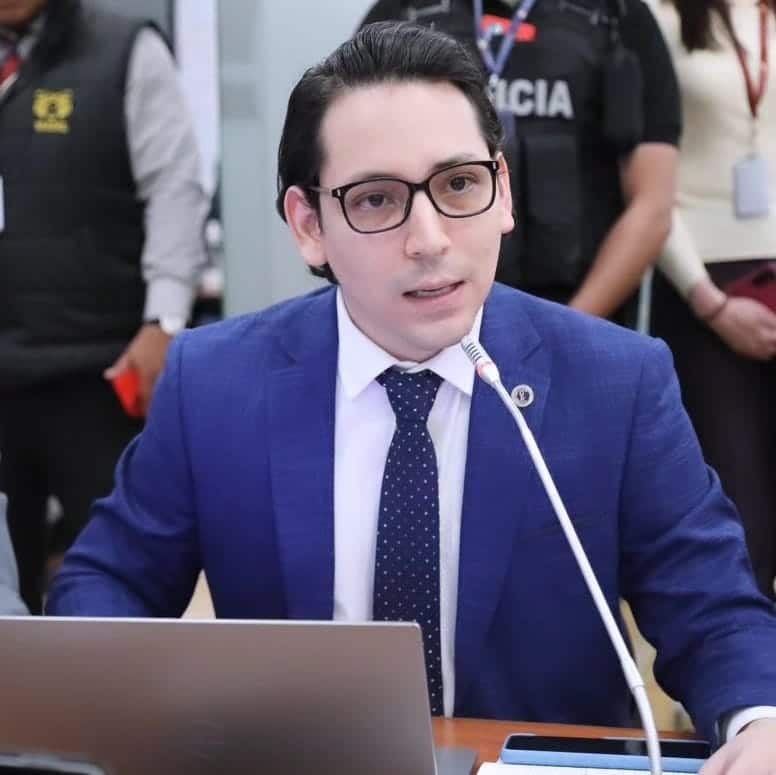
Law Degree from Universidad Católica de Santiago de Guayaquil - 2019
Master's Degree in Constitutional Law from Universidad Tecnológica Ecotec - 2022
Master in Administrative Law with mention in Public Contracting by the Universidad de Especialidades Espiritu Santo - 2024
Student of the Specialization in Jurisdictional Guarantees and Integral Reparation by the Instituto de Altos Estudios Nacionales (IAEN) - 2024.
Higher Diploma in Theory of Legal Argumentation by the University of Espiritu Santo Specialties and the University of Genoa - 2022
Advanced Diploma in Public Administration by the Education Quality Accreditation Commission of Canada - 2022
Practicing attorney and consultant dedicated to business, political and constitutional issues.
Former parliamentary advisor to the National Assembly of Ecuador
Currently advisor to the Comptroller General of the State and university professor at the SEK International University (UISEK).
Author of the book: «Constitutional Development of Ecuadorian Parliamentary Law», first edition December 2023.
Member of the Network of Parliamentary Experts of Ecuador by Fundación Haciendo Ecuador.

Universidad Espíritu Santo (UEES), began its academic activities in 1994 as a private, self-financed, non-profit institution. Its spirit of commitment and constant innovation are present in the quality of the service it offers to its community.