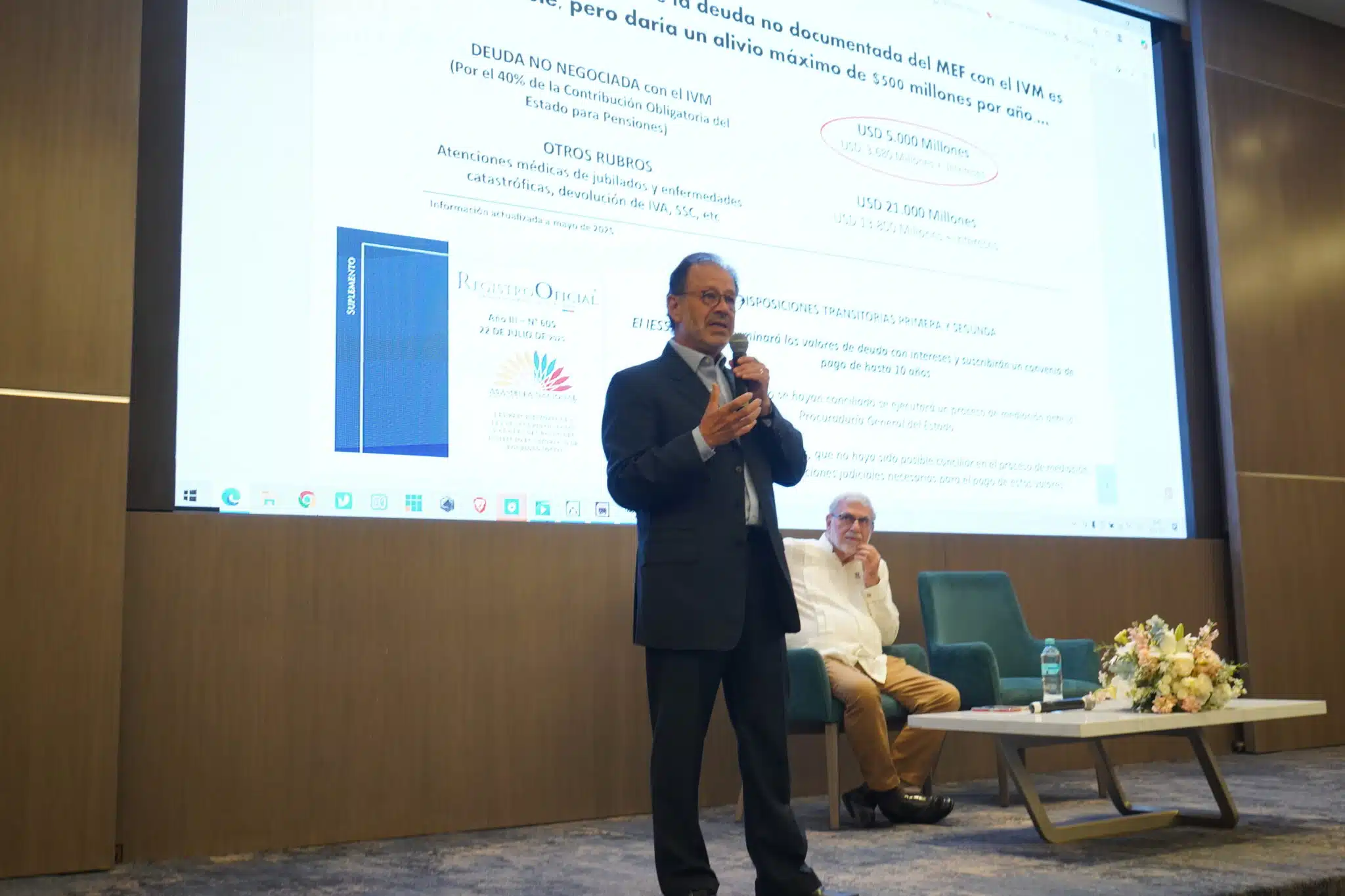
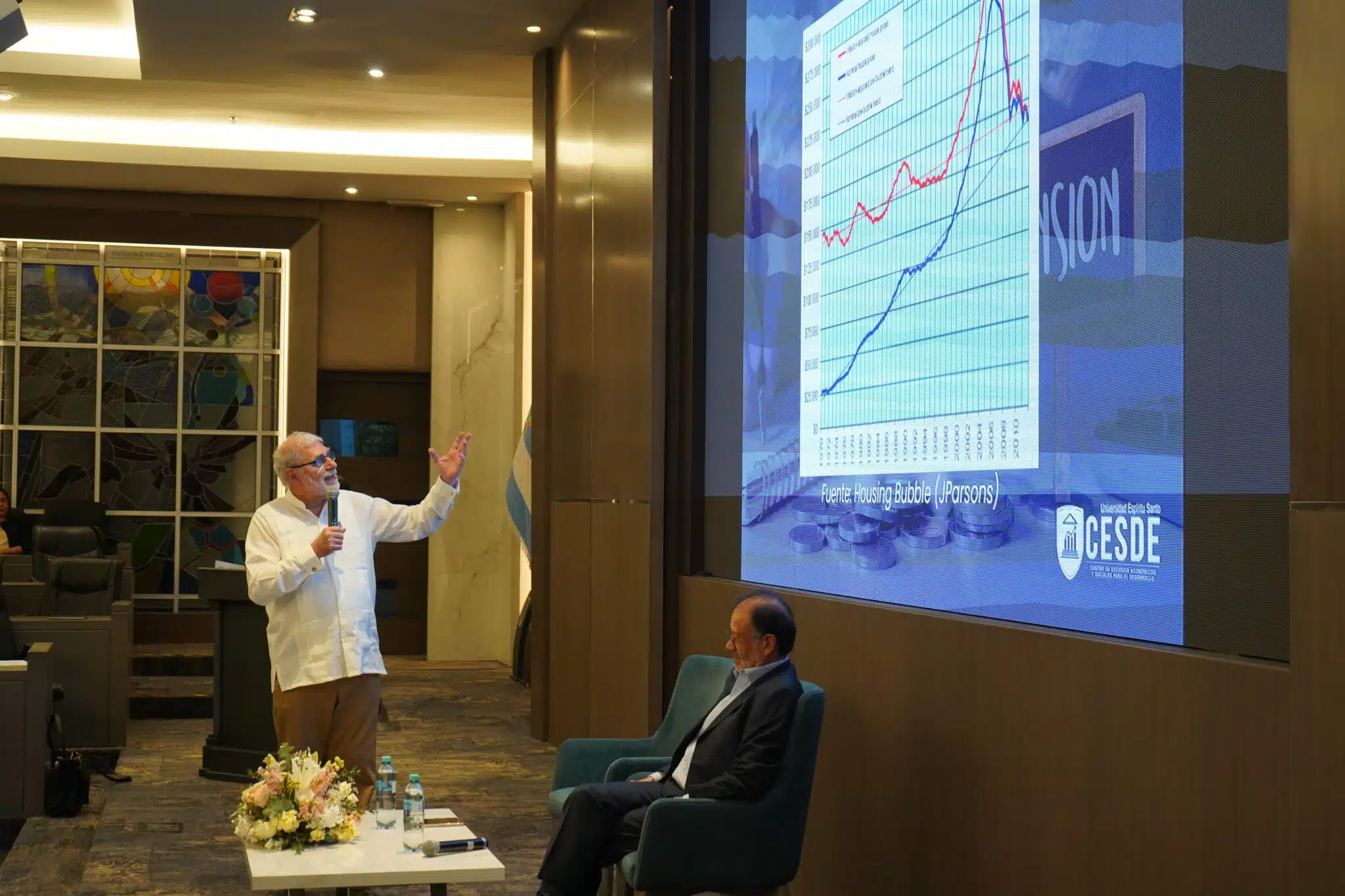
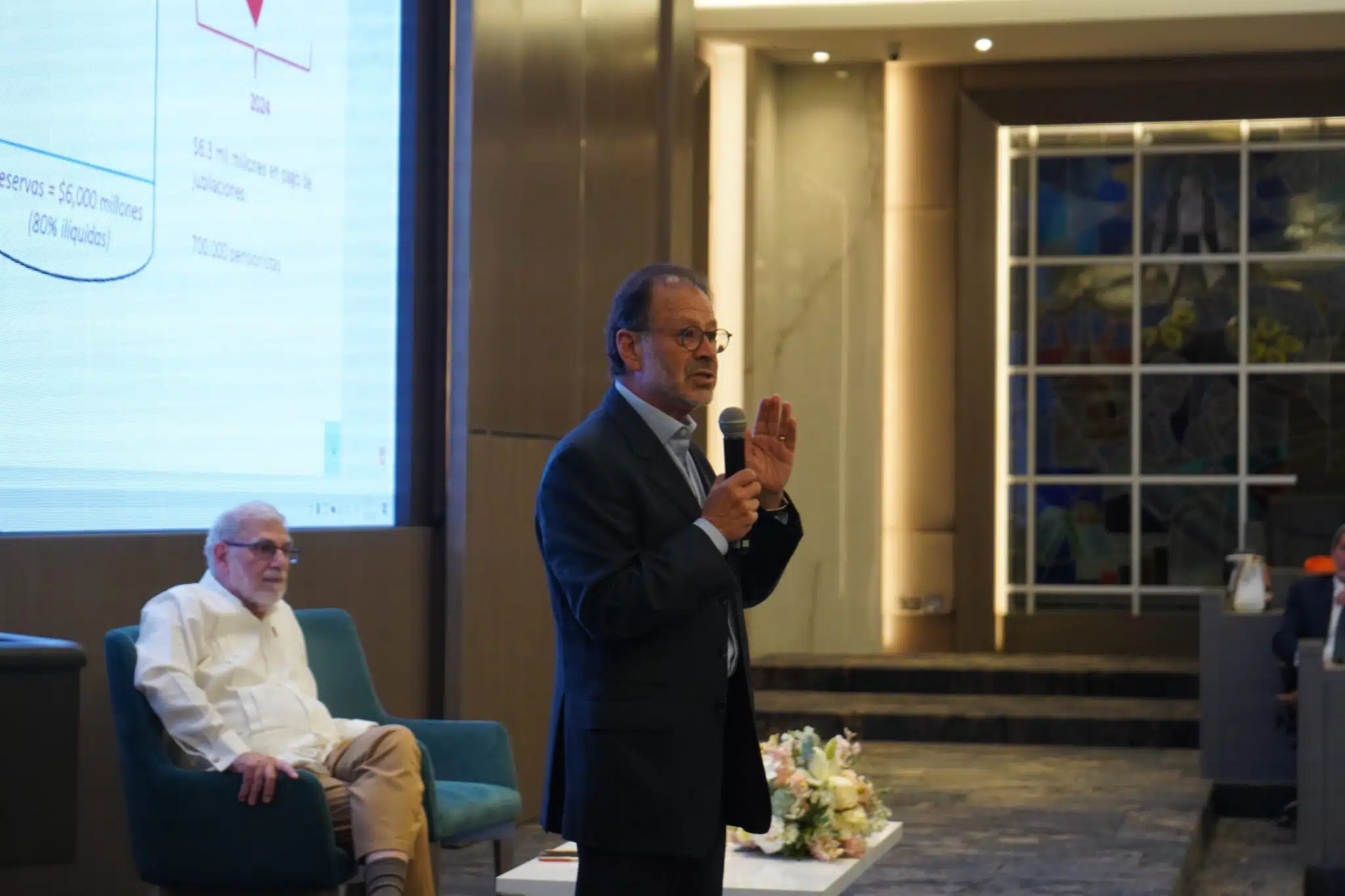
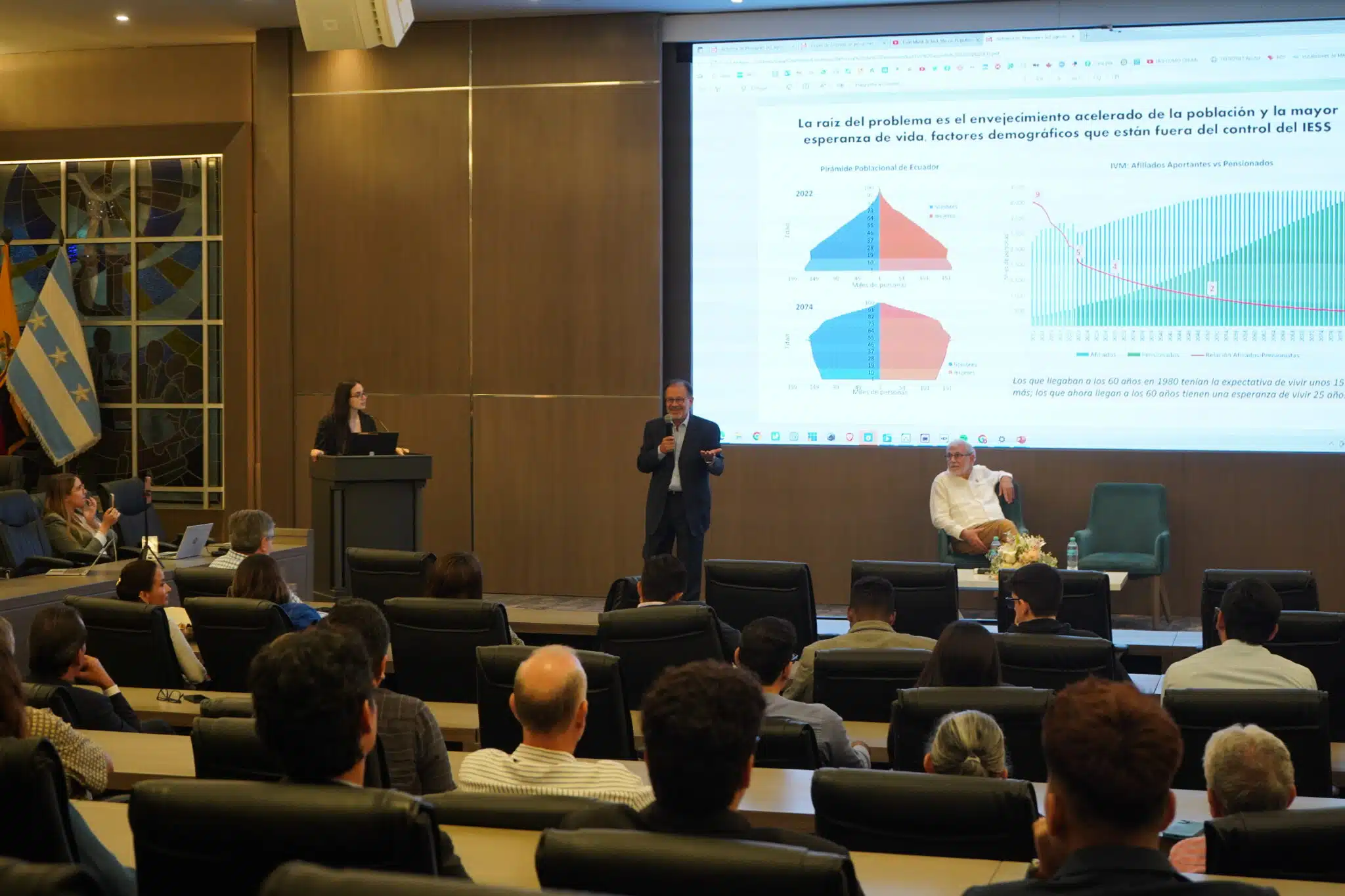
The Universidad Espiritu Santo (UEES) held a conference on “Analysis of the Pension System in Ecuador”.”, The event was a space for reflection and dialogue on the challenges and perspectives of this important economic and social pillar of the country. The event was attended by: Augusto de la Torre, Specialist in Macroeconomics and Financial Development, Professor at Columbia University and Alberto Dahik, Director of the Center for Economic and Social Studies for Development (CESDE) and Director of Graduate Studies at UEES.
Alberto Dahik began the discussion by referring to two historical economic events worldwide: the 1929 crisis and the 2008 crisis. He explained how in both cases, they were predictable but ignored due to social denial. He pointed out that the level of contributions in the country is lower than in the region and that there is citizen resistance to change.
“It's not the fault of any government, it's the fault of a decades-old financial architecture,” the economist said.
In addition, Dahik highlighted the growing indebtedness of the State with the IVM fund (Disability, Old Age and Death fund) and the risky use of bonds and mortgage loans by the IESS. Finally, he warned about demographic pressure: fewer young members supporting a growing number of retirees who are living longer.
Augusto de la Torre, for his part, explained the reform proposal prepared by the commission he led and presented during the government of Guillermo Lasso to save the pension system from collapse. He pointed out that the basic deficit of the IVM continues to increase, even if the State complies with the payment of the 40 % of the fiscal subsidy and its debts, since even then it would not be covered. He also warned about the demographic impact, pointing out that While at the beginning of the century there were nine members for every retiree, by 2030 the projection is only four.
De la Torre also exposed the inequities of the IVM, by demonstrating that higher-income members receive 8.3 times more than they contribute, while low-income members receive 5.8 times more than they contribute., This is evidence of an inequitable and inefficient system. He added that many Ecuadorians do not join until they are 60 years old, further weakening sustainability. He explained that the reform proposed, but not implemented at the time, sought to correct these distortions, make the system fairer, more financially and fiscally reliable, and avoid a crisis which, without structural changes, is inevitable.
Both speakers called for the proposal not to be forgotten, stressing the urgency for civil society and academia to become actively involved and maintain the demand for a solution. They warned that, if this is not done, present and future generations will be the ones to bear the consequences.
Universidad Espíritu Santo (UEES), began its academic activities in 1994 as a private, self-financed, non-profit institution. Its spirit of commitment and constant innovation are present in the quality of the service it offers to its community.