This article conducts an analysis of three relevant challenges to the legitimacy of the Inter-American Human Rights System. They refer to inter-American standards, respect for due process, and the nature and proportionality of reparation measures. The analysis includes both a diagnosis of each of these challenges and the outline of a proposed solution.
Read complete articlePublished in: International Journal of Constitutional Law, Volume 19, Issue 4, October 2021.
 Dr. Carlos Bernal Pulido
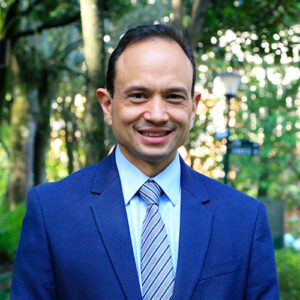 Dr. Carlos Bernal Pulido
Guest professor of the Master in Law, mention in Business Law and Master in Negotiation, Mediation and Arbitration of the Graduate School of Law UEES.
Carlos Bernal is Commissioner of the Inter-American Commission on Human Rights for the 2022-2025 term. He is also a professor at the law school of the University of Dayton, Ohio, United States, and the Universidad de la Sabana, Colombia. He is a guest professor at the master's programs of UEES. He was a Magistrate of the Constitutional Court of Colombia (2017-2020). He is a lawyer from the Universidad Externado de Colombia (Bogotá - Colombia) (1996), Doctor in Law from the University of Salamanca (Spain) (2001) and Magister (2008) and Doctor (2011) in Philosophy from the University of Florida (United States). He has been a professor at the Universidad Externado de Colombia, Macquarie University in Sydney, Australia and the University of Florida. He has also been visiting professor at the law schools of the Sorbonne University in Paris, Paris X (Nanterre) and León University (Spain), and visiting researcher at the law schools of Yale University, Kings’ College London and the Max Plack Institute for Comparative Public Law and International Law (in Heidelberg, Germany).
Carlos Bernal is the author of books, journal articles and chapters on topics related to the protection of human and fundamental rights, democratic constitutionalism, constitutional creation and change, the ontology of law and the theoretical foundations of civil and state responsibility. His work has been published by the most prestigious publishers and indexed journals in Spanish, English, French, German, Italian, Portuguese and Russian. According to Google Scholar, he is one of the most cited authors in the world in the fields of constitutional theory, theory of law, philosophy of law, comparative law and constitutional law.