

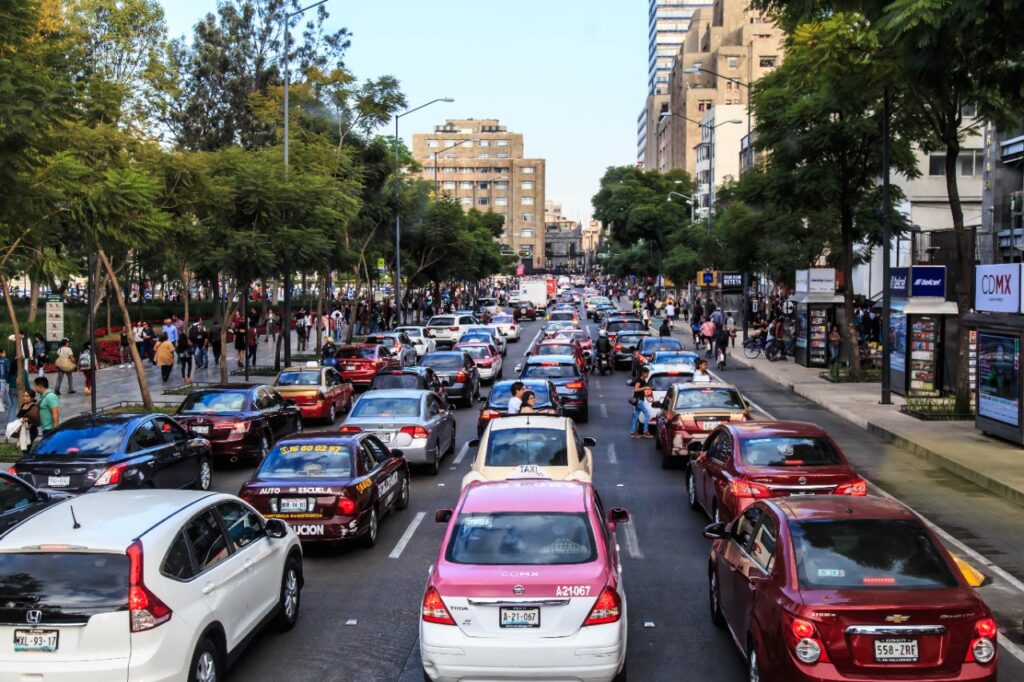
Greater Guayaquil, known for the conurbation of the city of Guayaquil with other neighboring parishes, mainly Guayaquil, Durán and Samborondón, presents problems of traffic congestion especially during peak traffic hours, mainly during the periods between 6:30 am - 8:30 am and 4:30 pm - 7:00 pm, which correspond to the hours of departure and entry to work, respectively.
There are several reasons that lead to congestion such as poor timing of traffic lights, incorrect traffic distribution, road culture, etc., but mainly the problem in the cities is the low road capacity to cope with the traffic demand that grows year after year. According to the Municipal Transit Agency (ATM) the vehicle fleet in Guayaquil has an average annual growth of 45,000 vehicles.
Given this scenario, it is possible to increase capacity, a complicated proposal due to the established urban configuration of narrow streets, little existing vertical property and that, if applied, would lead to expropriations or reduce demand, as is done in Quito, with the "pico y placa" system. The latter option is only a palliative, since as the number of vehicles continues to grow, the system will eventually collapse.
An alternative solution, then, is to have an efficient urban transportation system, which, as logic dictates, would transport more people while occupying less road space, thus increasing road capacity. This urban transportation system would be complemented in a more effective way by using the multimodal concept, typical of exports, which consists of the concept of carrying goods using various methods of transportation.
Guayaquil currently has the Metrovía and the Aerovía (which also connects Durán) systems, which should have common stopping stations to generate connectivity. Additionally, taking advantage of the Guayas, Babahoyo and Daule rivers, the multimodal proposal should be complemented with a river transportation system to connect Guayaquil, Durán and Samborondón.
The multimodal system does not only consist of the interconnection of the means of transportation used, it is necessary to make modifications to urban infrastructures such as parking lots, traffic restrictions on certain roads, mainly where the land transportation infrastructure is located and, as a relevant point, it must be economically accessible so that its use is massified.
If the multimodal system is efficient, fast, affordable, with great coverage and safe, the user will balance the cost-benefit of using public transportation or a private vehicle, with a high probability of choosing the first option.
In addition, another benefit aligned with the Sustainable Development Goals (SDGs), by employing this multimodal system and implementing the use of electric vehicles, is the significant reduction in the emission of polluting gases derived from the combustion of fuels (coal and oil derivatives), generating a positive impact in combating climate change and its effects on the world.
Eng. Andrés Cassagne
Faculty of Engineering