
In the world of cardiovascular medicine, a concept has just been born that promises to put a name and a face to a silent problem: cardiovascular disease. Gulliver syndrome. Created by an international team led by José Francisco López-Gil, research professor at Espiritu Santo University, this term describes people who do not have an “alarming” risk factor for heart disease, but who accumulate several values slightly out of the ordinary (such as obesity, blood pressure, sugar or cholesterol) which, when added together, dangerously increase the risk of cardiovascular disease. According to scientific data, even modest elevations can increase the risk of coronary heart disease by more than 30 % over a lifetime.
The name is inspired by Jonathan Swift's famous literary character, Lemuel Gulliver, who, despite his size, is immobilized by many tiny ropes laid down by the tiny inhabitants of Lilliput. Similarly, those suffering from Gulliver's syndrome are “tethered” by small health imbalances: waist circumference slightly larger than recommended (90-101 cm in men and 80-87 cm in women), elevated glucose (101-125 mg/dl), elevated blood pressure (121-139/81-89 mmHg), and non-HDL cholesterol slightly above the ideal range (130-189 mg/dl). Each “string” seems harmless on its own, but together they can immobilize cardiovascular health and multiply the risk of heart attacks and strokes.
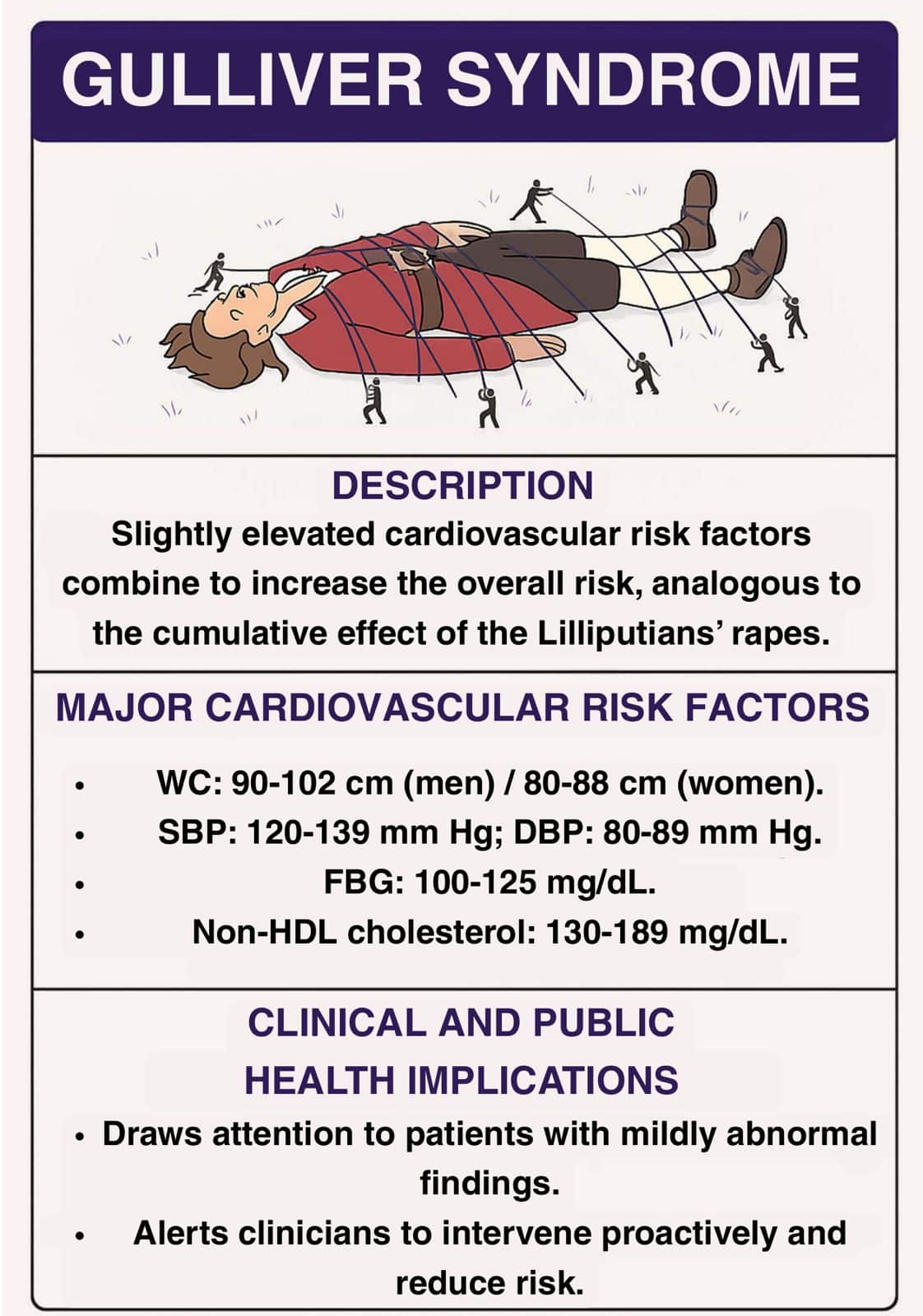
“Gulliver's syndrome reminds us that we don't have to wait for an alarm to sound before we act. Many small maladjustments, which individually seem harmless, can add up and become a major threat to the heart. Detecting and treating them early can make the difference between a healthy life and a preventable cardiovascular event.”.
This conceptual framework not only helps to identify a group of patients that often goes unnoticed in consultations, but also combats the so-called “therapeutic inertia”: the tendency not to initiate treatment because no individual indicator exceeds the alarm limits. Studies show that up to 50 % of patients with multiple mild risk factors remain without clinical intervention, despite having a moderate or high cardiovascular risk in 10-year projections. Early detection of a Gulliver syndrome will allow physicians to act earlier, adjusting lifestyle or even using preventive medication, thus preventing small problems from becoming big threats.
Moreover, its impact goes beyond the medical consultation. Knowledge of the term and its meaning can empower the population to take a more active role in their health, requesting comprehensive evaluations and not just isolated check-ups. In a context where cardiovascular diseases continue to be the leading cause of death in the world - responsible for more than 30 % of global deaths - this preventive approach opens the door to more accurate diagnoses, earlier interventions and, ultimately, to saving lives that were previously lost due to “small details” that no one paid attention to.


Universidad Espíritu Santo (UEES), began its academic activities in 1994 as a private, self-financed, non-profit institution. Its spirit of commitment and constant innovation are present in the quality of the service it offers to its community.