



Project name
Evolution of the epidemiological profile of occupational accidents in the Republic of Ecuador.
Academic Unit
Graduate School
Ecuadorian Observatory of Occupational Safety and Health (OESST)
SDGs 3 and 8
Background
The Ecuadorian Observatory of Occupational Safety and Health (OESST) of Espiritu Santo University, formed in April 2018, has conducted research studies in line with the Sustainable Development Goals and targets.
Activities
Study 1: SOCIO-LABOUR DETERMINANTS ASSOCIATED WITH WORK-RELATED INJURIES: A SAMPLE OF 4,562 WORKERS IN ECUADOR
Several socio-labor determinants, in addition to occupational hazards inherent to the work occupation, are associated with the probability of occurrence of non-fatal work-related injuries (NWI). The aim of this article is to determine the prevalence and association between sociolaboral factors and the probability of occurrence of LAT in Ecuador. Cross-sectional study with a nationally representative sample of 4,562 affiliated workers in the private sector. The socio-labor characteristics of the worker were the explanatory variables and LAT was the outcome variable.
Study 2: PERCEIVED HEALTH STATUS OF YOUNG, ADULT AND OLDER WORKERS IN GUAYAQUIL - ODS 3
At present, it is notorious the importance of knowledge about the health status of workers and its relationship with age and sex, due to normal aging and the prevalence of specific ailments and symptomatologies. However, there are few studies on this problem in our country. In this sense, the aim of this study was to compare the differences in risk of the main health problems in adults and older versus younger people by sex. For this purpose, we used data from the application of the First Survey on Safety and Health Conditions at Work (I-ECSST) in a representative sample of workers in the Ecuadorian city of Guayaquil (n = 1049). In general, women reported more health problems than men. The probability of suffering discomfort in the upper limbs and head and gastrointestinal, ophthalmologic and cardiocirculatory problems increases with increasing age in women. The different findings suggest the need for further studies to clarify the explanatory factors of health status. Until then, health promotion actions should be reinforced in the older working population, since they are preventable predictors of mortality.
Study 3: LONG WORKING HOURS AND OCCUPATIONAL ACCIDENTS: RESULTS OF THE FIRST SURVEY ON SAFETY AND HEALTH CONDITIONS IN ECUADOR - ODS 8
Long working hours can contribute significantly to health damage in workers, including injuries due to occupational accidents.
Objective: To estimate the relationship between working days per week and occupational accidents in the salaried population of the Ecuadorian city of Guayaquil.
Methods: The analysis was performed using data from the First Survey on Occupational Safety and Health Conditions in the Republic of Ecuador (I-ECSST). The respondents of this study were 1005 salaried workers and were divided into two groups according to weekly working hours, ≤43 and ≥44 h.
Study 4: DIFFERENCES IN MORTALITY DUE TO TRAFFIC ACCIDENTS ACCORDING TO OFFICIAL SOURCES IN THE REPUBLIC OF ECUADOR - ODS 3
To know the differences between police records and medical certificates of death by transit in the Republic of Ecuador. Observational study with data from official sources of information between 2017 and 2019. Mortality rates were compared for both sources by age and sex groups. The data were analyzed with the SPSS statistical package. During the study period, 7 291 traffic fatalities were recorded in police records versus 9 509 in medical certificates. Mortality rates varied significantly by age and sex between data sources. The mortality rate according to police records shows a decrease, but no significant change according to medical death certificate data. Significant variations in age and sex profiles by data source are evident. At the same time, they support the need for the use of medical death certificates as a source for calculating indicators. Given that data from police records underestimate real mortality and mask the effectiveness of road safety policies in recent years.
Death rates specific to road traffic injuries according to sources of information by sex and age groups. Republic of Ecuador, 2017-2019.
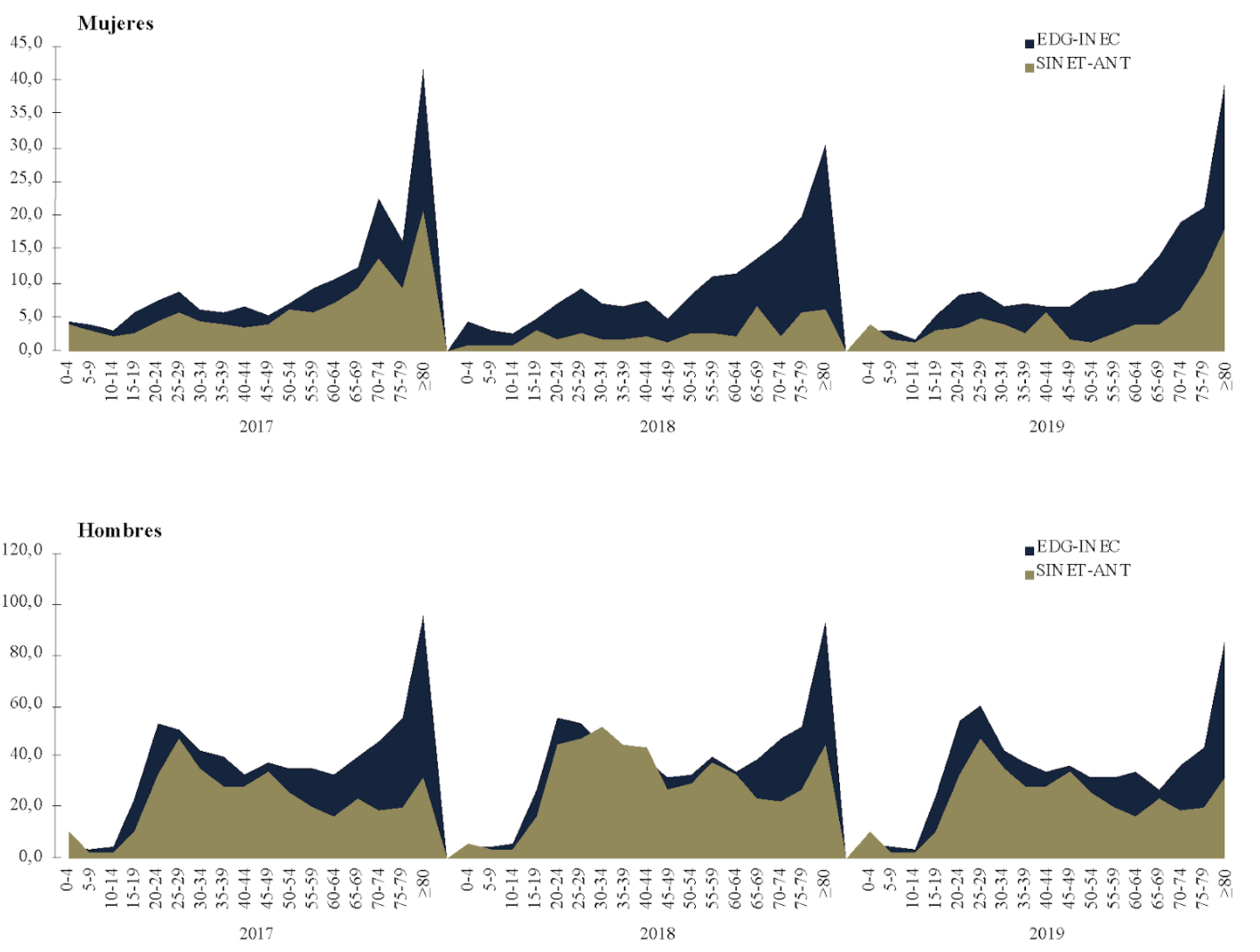
SINET-ANT: National Traffic Statistics System of the National Traffic Agency. EDG-INEC: General Death Statistics of the National Institute of Statistics and Census.
Study 5: MORTALITY DUE TO TRAFFIC INJURIES IN OLDER ADULTS IN THE REPUBLIC OF ECUADOR: 1990 - 2018 - ODS 3
The present study aimed to estimate the trend in mortality due to traffic injuries in older adults (≥60 years of age) and the comparison with those <60 years of age in Ecuador (1990-2018). Death records and official demographic projections were used to calculate mortality rates per 100,000 population, rate ratios, years of potential life lost (YPLL) and trends. The <60 years of age recorded mortality rates of 16.7 (per 100,000) compared to 36.2 (per 100,000) in older adults, with an increasing trend in DALYs. Older adults recorded fewer cases of deaths in relation to the younger population. However, it is necessary to develop road safety strategies oriented to the progressive aging of the Ecuadorian population.
Ratio of road traffic injury fatality rates in persons aged ≥60 years and older to those under 60 years.
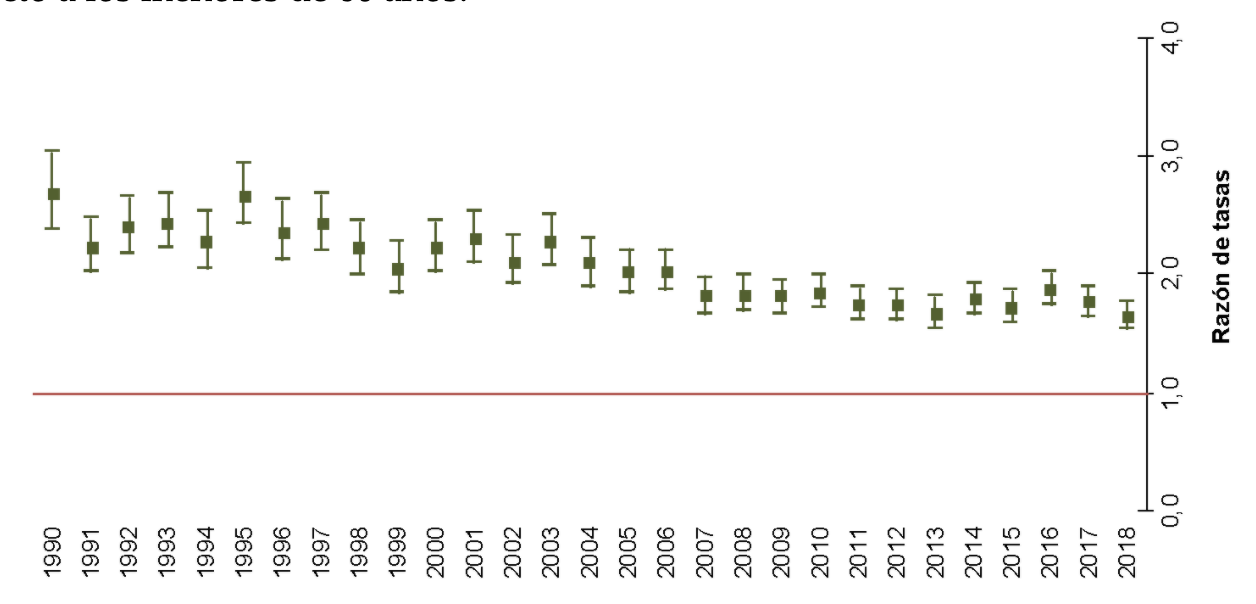
Similarly, and in reference to Target 3.6, the age-adjusted mortality rates differ; the most vulnerable group is identified as the elderly population.