


Industry 4.0 is a reality that challenges us, factors such as big data, hyperconnectivity, agility, generational change, the smart products industry, internet services are part of our daily lives; this gives us light to identify the path to the future. In other words, industries must undertake digital transformation because if they keep their traditional business, they are at risk of disappearing. Currently, many successful organizations that have opted for this path have focused on 4 points: 1) Structure or governance, 2) People or culture, 3) Processes (agility) and 4) Technology (enabling).
In this sense, human talent management takes a leading role in the different industries, since two of the four factors that lead to digital transformation are their responsibility: governance and culture.
This new framework requires organizations to change their mindset without abandoning their raison d'être, to become more agile and to seek value for the customer (Customer Law); to do so, we must separate strategic management from strategic execution.
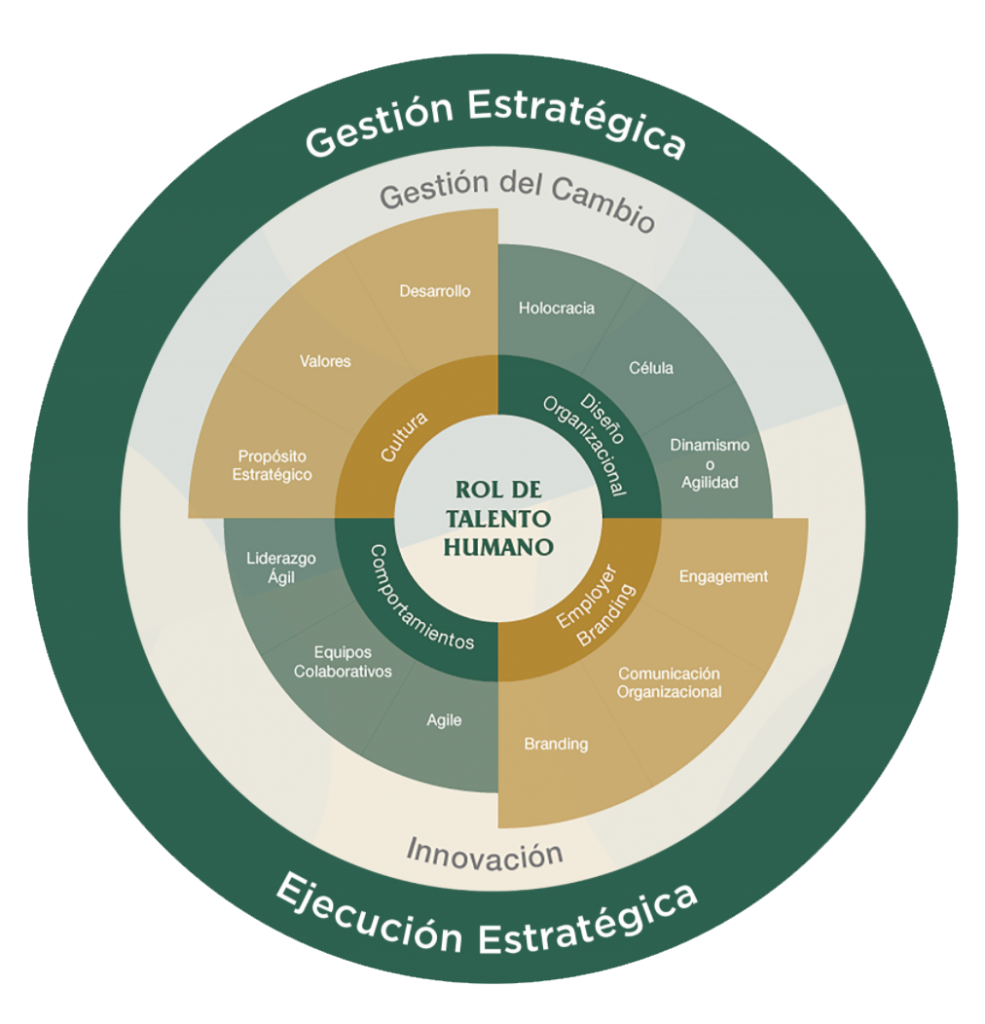
Strategic management defines the organizational culture from the moment it establishes the purpose, values, behaviors, until it incorporates them into the daily performance of employees through training and development. Another aspect considered by strategic management is the redesign of the organization's structure to move from a traditional or hierarchical model to a dual model, i.e., combining a hierarchical structure with a cellular structure (Network Law).
Once the strategic management is defined, we enter into the strategic execution, which is the one that will spread and develop the agility framework in the organization, where leaders are the main actors and their participation and commitment are essential in the change to integrate collaborative teams (Small Team Act) that adopt agility as part of their behavior. Complementing the above, employer branding plays an essential role, where it is necessary to foster a high engagement of the work team, generate practices that add value to the employee and finally turn him/her into an ally and fan of the brand. All this contributes to stimulate in the employees their commitment, the pleasure of doing their job and the pride for belonging to the organization. In this process, internal communication plays a transcendental role.
All of the above is shown in the following chart:
To conclude, it is necessary to mention that the challenge is very big, the executives of the organizations must be aware of the importance of what sounds esoteric. In addition, it is necessary that they analyze and study the industries that took the path of digital transformation and are now success stories.
Mgs. Diego Ambrossi
Online Master's Degree Teacher




Excellent, the challenge is now!
Excellent article. Very clear, very true, it gives you a north for future actions. Congratulations
Excellent article and congratulations for making Human Talent professionals aware of a reality that is already being experienced.
I am left with questions such as what kind of organizations can access to change the organizational structure to this new digital era, at first I think that organizations such as Cerámica Graiman of the city of Cuenca, has both economic and human resources to generate this great change.
In this context, implementing the change in the new digital era is for all organizations or what it depends on to change, since there are many organizations that still work in a vastly traditional system, even the famous Kardex, typewriter or calculators among others.
Thank you for your response to my comment.
Best regards
Juan Xavier Chuqui Sanchez
Congratulations my dear Diego. Today more than ever organizations must make the leap to people. We have filled ourselves with a rigid and heavy armor full of labels and models and we have forgotten the essence of the human being. It is essential to work on the management of culture and to value the intangible. A big hug and thank you very much for sharing your experience.