

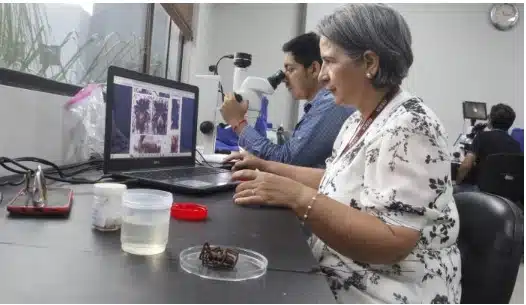
The Universidad Espiritu Santo (UEES) has achieved an important scientific breakthrough by discovering two types of spiders that are considered unique in the world. This outstanding research, the first of its kind in the Americas, was carried out by biologists Mauricio Macias and Natalia Molina.
These small arachnids, brown in color and no more than two centimeters in size, were found in the mangroves of the islands of Santay and Puná, during the study of natural areas conducted by the UEES Research Center. The new types of spiders have been denominated as Chapoda santay and Chapoda guancavilca.
Mauricio Macias, one of the researchers responsible, commented: «Collecting the samples, that is, thousands of spiders, was the first step. During one year we collected more than 10,000 specimens. For many researchers, finding a new species is a dream, and in this team we managed to discover two».
This research program goes beyond this specific finding, as it will encompass the comprehensive study of mangroves, with a projection until 2050. The researchers hope not only to make new discoveries, but also to raise awareness of the need to protect the country's mangroves.
Natalia Molina, another of the biologists in charge of the research, emphasized: «At present, with the proximity of an El Niño event, it has been demonstrated that mangroves play a crucial role in coastal protection. In 1969, Ecuador had 200,300 hectares of mangroves, while by 2006 only 149,000 hectares remained, which means a loss of 54,000 hectares. It is very likely that the current figure is even lower».
UEES is proud of the achievements of its scientists in this research and reaffirms its commitment to protecting the environment and promoting environmental awareness.