

Master's Degree in Procedural Law

Título a obtener

Title to be obtained

Master in Procedural Law
Resolución

Resolution

RPC-S0-36-No. 666-2019

Duration

12 months

Study your LLM at UEES and apply for an international double degree.

Our master's students will be able to apply, simultaneously and with unbeatable academic and economic benefits, for an international double degree:
Online Master of Laws (LL.M.) from University of Dayton School of Law
LL.M. for Foreign-Trained Lawyers of Temple School of Law

Obtain your degree in only 1 year

Objectives

To train fourth level professionals capable of understanding in depth the fundamentals of procedural institutions, their relevance as a mechanism for the peaceful resolution of controversies and their role as an indispensable tool to guarantee the rights of the parties and defendants within the framework of the administration of justice.

Curriculum

  • General Theory of Process
  • Criminal Proceedings
  • Organic Procedural Law and Administration of Justice
  • General Theory of Evidence
  • Constitutional Processes in Jurisdictional Guarantees
  • Degree I: Research Methodology
  • Intellectual Property Proceedings
  • International Human Rights Proceedings
  • Mediation and Arbitration Proceedings
  • Contentious-Administrative and Contentious-Tax Proceedings
  • Procedures at Central and Decentralized Administrative Headquarters
  • General and Voluntary Litigation Proceedings
  • Oral Litigation
  • Degree II: Degree Work or Complexive Examination

Class schedules

Saturdays and Sundays from 08:00 to 17:00

University of Dayton - School of Law

Temple University - Beasly School of Law

Agreements

We maintain academic cooperation agreements with national and international universities and public institutions, among them:

Convenios de cooperación

Financing

The Master's Program can be financed through credit with any banking institution.

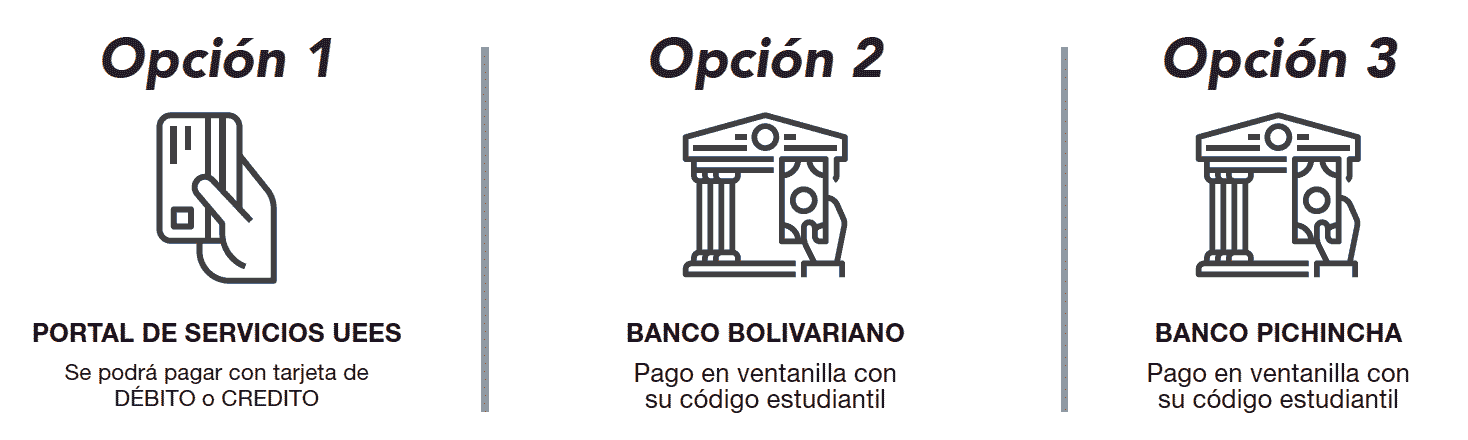
Means of payment
Enrollment, tuition and fees for the master's program can be cancelled in the following ways:Medios de pago
Objectives

To train fourth level professionals capable of understanding in depth the fundamentals of procedural institutions, their relevance as a mechanism for the peaceful resolution of controversies and their role as an indispensable tool to guarantee the rights of the parties and defendants within the framework of the administration of justice.

Methodology

  • Case Analysis
  • Keynote Speeches
  • Participation of renowned speakers during the classes
  • Teamwork

Curriculum

  • General Theory of Process
  • Criminal Proceedings
  • Organic Procedural Law and Administration of Justice
  • General Theory of Evidence
  • Constitutional Processes in Jurisdictional Guarantees
  • Degree I: Research Methodology
  • Intellectual Property Proceedings
  • International Human Rights Proceedings
  • Mediation and Arbitration Proceedings
  • Contentious-Administrative and Contentious-Tax Proceedings
  • Procedures at Central and Decentralized Administrative Headquarters
  • General and Voluntary Litigation Proceedings
  • Oral Litigation
  • Degree II: Degree Work or Complexive Examination

Class schedules

Saturdays and Sundays from 08:00 to 17:00

University of Dayton - School of Law

Temple University - Beasly School of Law

Agreements

We maintain academic cooperation agreements with national and international universities and public institutions, among them:

Convenios de cooperación

Financing

The Master's Program can be financed through credit with any banking institution.

Means of payment
Enrollment, tuition and fees for the master's program can be cancelled in the following ways:Medios de pago

Entry Profile

Law professionals with a third level degree, duly registered with SENESCYT.

Professional profile to be obtained

The graduate of the master's program will be a professional with the competencies to:

  • Reflect critically and proactively on the application of Procedural Law, its principles and institutions in any of the positions he/she performs in society, whether in the field of free professional practice or as a public servant, whether administrative or member of the justice administration system.
  • Theoretical-conceptual and fundamentally contextual or pragmatic management of procedural science, this from the perspective of the doctrine of the institutions of adjective law that exist in Ecuadorian law and its consequent deepening, as well as the understanding in the praxis of real cases.
  • Solve complex legal problems based on the application of procedural principles and adjective hermeneutics.
  • Adequately adjust the legal claims through the procedural challenge mechanisms.
  • To apply voluntary civil proceedings when they are relevant to the claims of the plaintiffs.
  • Develop skills in challenging the acts of the public administration through administrative and tax litigation processes.
  • Develop litigation skills based on the application of the oral system in the formulation of case theories in matters regulated mainly by the General Organic Code of Procedure and other procedural norms.
  • Contribute to the construction and elaboration of procedural acts of judicial origin adequate for the fulfillment of the constitutional guarantee of motivation.
  • To apply jurisdictional guarantees and constitutional control mechanisms as ways to protect the constitutional rights of individuals.
  • Develop skills for international human rights litigation, either in the Inter-American Human Rights System or in the Universal Human Rights System.
  • Implement their oral litigation skills and procedural strategy in highly complex cases.
  • Research on the current procedural problems in judicial proceedings and coherently apply the institutions of procedural law contained, among others, in the General Organic Code of Proceedings that regulates the jurisdiction and procedural activity in various matters, as well as comply with the constitutional mandate of respect for the right to effective protection.

Admission Process

  1. Fill out the digital admission form, making sure to upload the following mandatory documents:
    • Identity card.
    • Title registration in Senescyt.
    • In the case of degrees issued abroad, the diploma must be duly apostilled or consular legalized.
  2. Make the payment of the registration fee (option included at the end of the digital form).
  3. Perform aptitude test.
  4. English test: A1 proficiency is required.
  5. Interview with the Director of the master's program.
Address

Km 2.5 Via Puntilla - Samborondón. Graduate School, Building P.

Tel.: (04) 500 0950 - Ext. 1274- 1299 - 1202 - 1220-1201
Cell phone: 0939317447 / 0959657803 / 0985218487 / 0999426904 / 0985009710 / 0999426904 / 0985009710
Email: postgrado@uees.edu.ec

Pablo Alarcón Peña

Director of the Graduate School of Law

The Graduate School of Law of UEES, according to its creation objectives, has a cutting-edge academic offer. This offer involves master's degrees, diplomas and other refresher courses, all related to law and other interdependent and related disciplines.