
By Katherine Calero
They appear and spread unchecked; they create fear, doubt, uncertainty and false expectations. There is not a single person who can say that he or she has not been a victim, even if only for a few seconds, of an avalanche of narratives deliberately put together by strangers to induce others to believe false facts or to cast doubt on facts that have already been corroborated. I am referring to the so-called “fake news” or fake news, which invade the most private spaces of readers without any periodicity or order whatsoever. At first sight they would have two particularities: they are created with a purpose, either economic or ideological, and apparently they would be seen as a journalistic genre; and that is when journalists question whether it is really possible to speak of “fake news”.
As defenders of the profession we know that information is news when it has complied with a process of verification of sources, so this phenomenon is nothing more than a propagation of unfounded rumors, with the difference that its dissemination scenario is not a beauty salon or a restaurant cafe, but a digital platform in which its issuers are common people disguised in social networks.
The creators of false texts are capable of transmitting messages of all kinds, in a very subtle way. They use the supposed authorization of experts, as well as moralization and rationalization, but what they use the most are emotions.
A clear example of this has been the world health crisis caused by the spread of COVID-19. This led the World Health Organization to coin the term infodemia to define a situation of fear and insecurity caused by the spread of rumors of all kinds related to the disease, which became much more dangerous than even COVID-19 itself.
False information has few limitations in terms of cost and production, so it is very easy to spread. Any person with harmful intentions would have the power to modify the behavior of users through the propagation of disinformation.
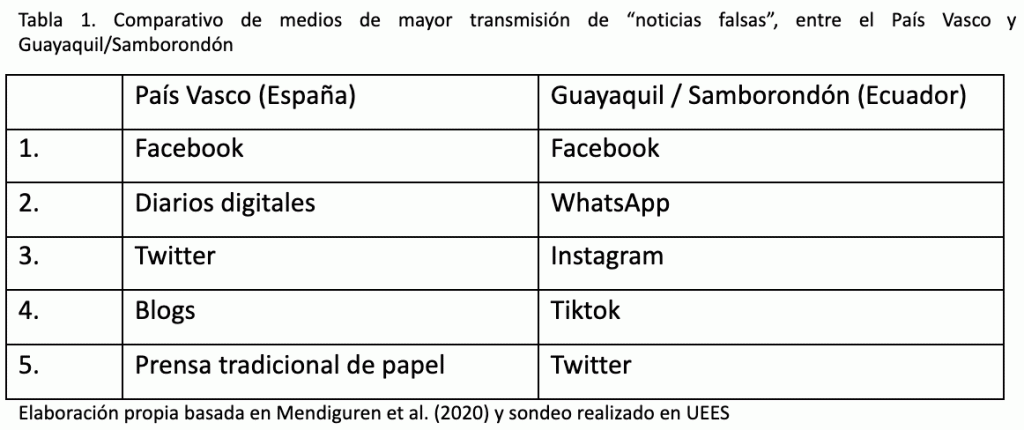
But the good news (and this is news because it was verified through research), is that young university students have a high rate of alertness to misinformation. A study conducted among students at the University of the Basque Country in Spain in 2020 revealed that 80% of those surveyed said they have the criteria to distinguish reliable information from unreliable information, while 74% admitted that today they are more distrustful, compared to a few years ago, of the information they receive daily from various channels. In general terms, they consider that nowadays there is more false information because anyone can publish information and it is easier to make and spread fake news on social networks.
Similar results were obtained through an opinion poll conducted among students of the Universidad de Especialidades Espíritu Santo in Ecuador. A 74% assured to have criteria to detect information with the verification of sources or with the contrast with other sources, being Facebook the social network where more fake news is published (28,29%) followed by WhatsApp (24,37%) as a complementary channel.
But how can we put an end to “fake news”? It is a challenging and complex answer to define; however, what can be recommended is that users always verify the contents that supposedly appear from official sources. Parallel to this, institutions should increase their reliable information accessible to the public and thus demonstrate transparency in communication.
The possibility of regulating content on social networks is a very delicate issue, as it may be very close to censorship as such, which would not be acceptable. Communication researchers working on this issue prefer to give a regulatory approach that they recommend should be addressed in the public debate in order to increase social awareness of the harmful effects left by the spread of false information.
Diario La Hora asks readers five questions whose answers will differentiate news from false information:
- Who writes it?
- Why is this information reaching me?
- Where is it published?
- What can be verified?
- What is the information like?
Undoubtedly, the rise of fake news has given rise to new areas of research for communication professionals, including ethics, reliability, information selection and content curation. As far as I am concerned, I insist that the term should not be fake news or “fake news”, but rather false information.
Bibliography
Boté-Vericad, J.-J. (2020). Fake News and Information Professionals’ Codes of Ethics. Telos Journal of Interdisciplinary Studies In Social Sciences, 22(3), 567-578. https://doi.org/10.36390/telos223.07
Galhardi, C. P., Freire, N. P., Minayo, M. C. de S., & Fagundes, M. C. M. (2020). Fact or fake? An analysis of disinformation regarding the covid-19 pandemic in Brazil. Ciencia e Saude Coletiva, 25, 4201-4210. https://doi.org/10.1590/1413-812320202510.2.28922020
Mendiguren, T., Pérez Dasilva, J., & Meso Ayerdi, K. (2020). Attitude towards Fake News: A case study of students at the University of the Basque Country Facing. Revista de Comunicacion, 19(1), 171-184. https://doi.org/10.26441/RC19.1-2020-A10