

For some years now, we have been hearing more and more insistently the word transmedia, which, although it may seem new, has actually been with us for a long time. Just think of a film franchise like Star Wars, whose first film was released in 1977. The story did not stay in the cinema, it crossed the screens and entered the homes of thousands of people in the form of comics, toys and video games. The story of Luke Skywalker found new narrative universes.
What has happened in recent years is that this concept of transmedia has been systematized, giving it a punctuality that, in its beginnings, was governed more by the intuitive than by the formal. Carlos A. Scolari in his work “Transmedia Narratives. When all media count” proposes the following definition: “when referring to Transmedia Narratives we are not talking about an adaptation from one language to another (for example, from book to film), but about a strategy that goes much further and develops a narrative world that encompasses different media and languages” (2013, p.21). This difference cited by Scolari is key to understand and develop proposals, since transmedia goes beyond formats. The author continues as follows:
In this way, the story expands, new characters or situations appear that go beyond the boundaries of the fictional universe. This textual dispersion that finds in the narrative its guiding thread -although it would be more appropriate to speak of a network of characters and situations that make up a world- is one of the most important sources of complexity of contemporary mass culture (2013, p.21).
It is interesting to note the author's idea of textual dispersion, since that is exactly what happens with transmedia. Ideas multiply and seem to get lost in an infinite world of possibilities. It is our responsibility as content producers to ensure that this dispersion has a common thread, so that what is produced in the different media supports each other, taking into account each of the characteristics and strengths of each of them. In other words, the new products generated from a mother idea must have a sufficient degree of autonomy so that they can be understood by any consumer who approaches them, without necessarily having seen the product from which the whole universe is developed. What is also sought with this proposal is to get consumers involved, so that they change and become prosumers.
Masterchef Case
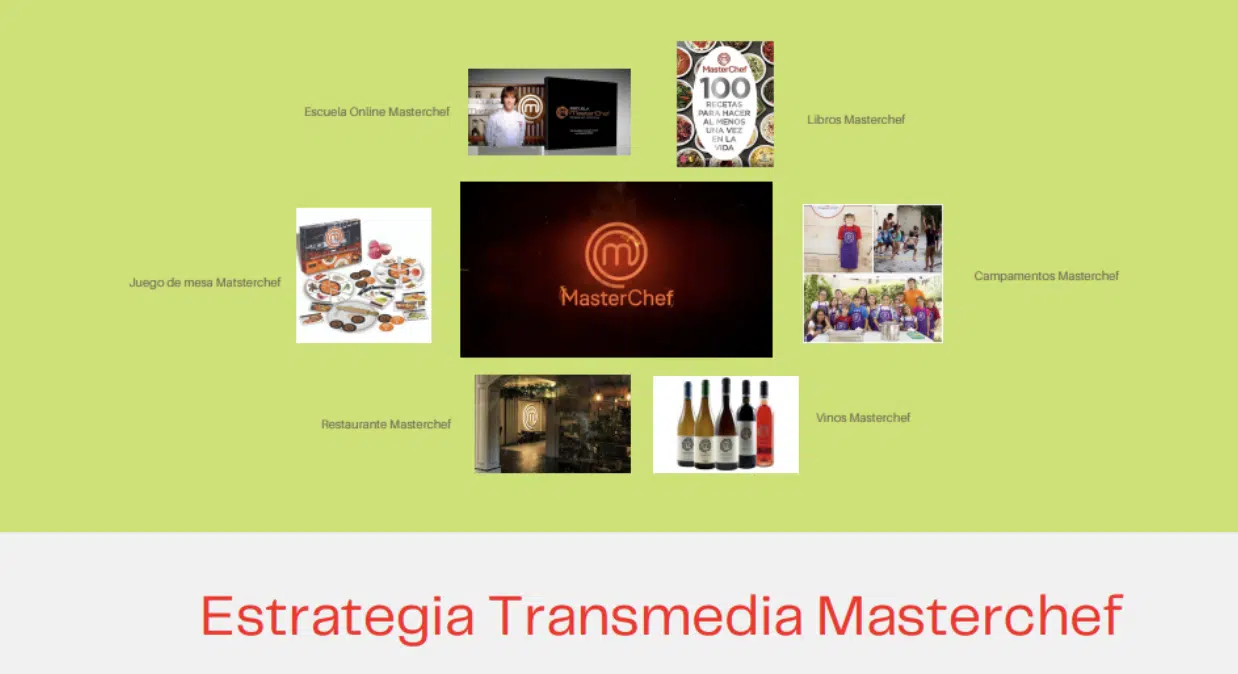
To better understand the construction of this transmedia universe and its textual dispersion, let's cite an example: the talent show Masterchef in its Spanish version. The program, which has been broadcast on Televisión Española since 2013, is one of the great references of what can be achieved with transmedia.
Masterchef is a show in which amateur cooks go through different weekly tests in search of winning the title, receiving a cash prize and boosting their gastronomic career. In Spain, in addition to the original version, there are two more: Masterchef Junior, in which children from 8 to 12 years old participate, and Masterchef Celebrity, in which the contestants are well known people from the world of cooking. In Ecuador we are days away from the premiere of the fourth season.
But let's get back to what concerns us, the transmedia universe. The format was well received by the public and immediately began to develop a strategy that today is worthy of imitation. The first thing that was launched was the Masterchef Online School (www.escuelamasterchef.com). The objective is clear, those who follow the program can learn from the characters who appear each week on screen. But the more traditional users have not been left behind, Masterchef has published a series of recipe books for those who prefer something physical, that stays with them. These first two products comply with that of textual dispersion, Masterchef expands, its derivative products can be consumed without being a spectator of the show, although inevitably, one generates interest in the other.
The transmedia universe continued to grow, with the creation of the Masterchef Camp, the opening of the Masterchef Restaurant and the Masterchef wine line. Now the public not only has access to products, but can also share experiences in the world of talent. All this without forgetting, of course, its social networks and official website.
As we can see, the opportunities are endless. The transmedia universe is there for us to create and generate new experiences. The world of marketing and communication has everything to explore and exploit it. With the development of the Internet and social networks, we are at the best time to do so. All it takes is planning and creativity.
References
Scolari, C., 2013. Transmedia narratives. When all media count. Barcelona: Deusto.
Ferri, E. (25 October 2018) Masterchef and its transmedia content. Transmediática. Blog about transmedia in television. https://transmediatica.wordpress.com/2018/10/25/masterchef-y-su-contenido-transmedia/
Pablo Velázquez V.