By: Marcia Fabara
In a time as atypical as the one we are living today, when our normality changed from one day to the next, where our daily habits and activities are no longer simple or carefree, and we are constantly facing challenges that we never thought we would experience in the flesh, it is the right time to take refuge in the corners of our creative voice and let it flow.
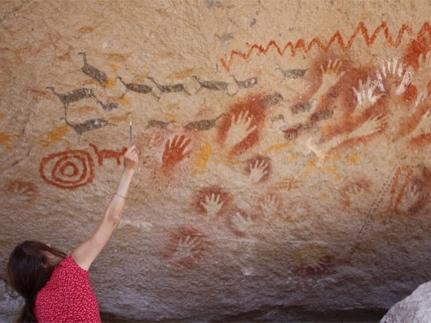
Historically, humans have been visually expressive beings. The Cueva de las Manos, located in Argentina, is an example of early visual expression. A work, which according to experts, dates back to approximately 7300 BC. The cave walls house a hybrid of hunting scenes and relief handprints, probably made by blowing paint materials through hollow bones or reeds. These overlapping illustrations provide a brief glimpse into a past life and build a present-day connection to our Stone Age ancestors.
Cave of the Painted Hands (Cave of the Hands)
Lately, an increasing number of people have found refuge and relief in more creative methods such as photography, music, drawing, painting, sculpture and a myriad of activities that were always thought to be extracurricular and of secondary importance. One of the most recurring methods of coping with our new reality is art.
Art has long been a way for societies to cope with tragedy and uncertainty. A great example is the work done by Franco Mormando, Professor of Italian and Chair of the Department of Romance Languages and Literatures at Boston College, and Thomas Worcester, professor of church history and president of Regis College in Toronto, who in 2005 held an exhibition called “Hope and Healing: Painting in Italy in a Time of Plague, 1500-1800,” at the Worcester Art Museum in Worcester, Mass.
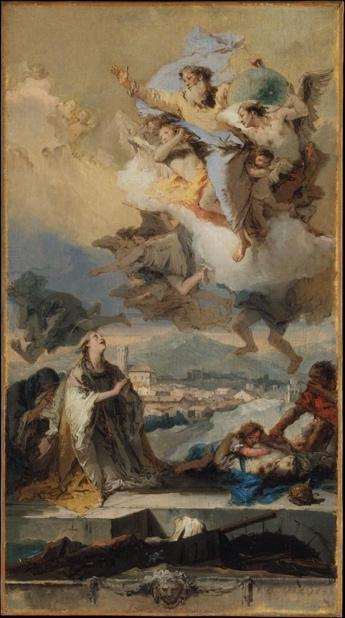
Saint Thecla Praying for the Plague-Stricken; Giovanni Battista Tiepolo, 1758-59
St. Thecla praying for those affected by the plague; Giovanni Battista Tiepolo, 1758-59.
This exhibition examines and shows visual art as a response to the repeated outbreaks of bubonic plague in Europe. As it comments Worcester in one of his interviews, where he emphasizes the interest in the Renaissance period up to early modern history within the European context, since the plague was something that recurred frequently and influenced on all sorts of levels: not only medical but broadly on a cultural and religious level. Italy, for example, is a Catholic culture with much emphasis on the visual. A clear cultural reflection of the society in that period.
In the same way Mormando points out that «art reflects reality. And by reflecting that reality, it helps us to understand it and how to respond to it». In times of crisis, people seek to reflect their experiences through other media. Visually striking media, which create empathy and touch our deepest emotions. Art or artistic expressions help us find solace by validating our emotions, especially at «safe» distances and as a consequence bring us relief and psychological comfort.
Then art becomes a healing and unifying method of expression. In times of crisis, we need humanity, expression and the community that the arts create. Making art and seeing art allows us to process our experiences. Art helps us to express and understand the world around us. It creates wellness in our daily lives by helping us process our lives individually and allowing us to come together collectively. Art allows us to communicate from afar, generating positivity, appreciation and hope. Art is an innate expression of what it means to be human.
Even though many of us fervently believe that we are not artists, that we were not born with the innate gifts and affinity for certain disciplines, they are undoubtedly skills that we should allow ourselves to explore without restrictions and curricular regulations. There is nothing more gratifying than letting the pencil run across the white spaces of a sheet, the colors of muddy paints in our hands marking the inanimate contours, tones and phonemes rising from our throats released to the wind, sliding fingers dancing on keys or strumming indistinct strings, swaying bodies expressing feelings, letters and words giving meaning to the voice of the soul.
The artistic veins that are hidden in each and every one of us, have found in this atypical time a permissible space, validated by a new reality in which it is necessary to reencounter, where it is important to slow down the pace and retake the taste for what we once wanted to try, but never decided to give it time. Finding or rediscovering that creative spark that was always with us has become the salvation of many and the dawn of others.
Maybe it's time to stop thinking that we don't know how to create art, that we don't have the talent or the time to cultivate it. If not, it is time to feel it, to let it invade us, to let it inspire us, to let it make us laugh or move us to tears. It is time to invite him to share our illusions and small conquests. It is time to paint for the sake of painting, to write because it fills our soul, to sing and dance because our body wants to vibrate with the sounds and the rhythm contained in our pores. The perfect time to feel that we can create thousands of different scenarios for our stories.
And as Pablo Picasso once put it «Art removes the dust of everyday life from the soul«For this reason and much more, I believe that today more than ever we can be sure, that art is essential.
REFERENCES:
Cueva de las Manos del río Pinturas (Argentina): World Cultural Heritage (UNESCO); https://www.cuevadelasmanos.org/investigacion.html; Retrieved June, 2021
Hope and Healing, Painting in Italy in times of plague; https://www.worcesterart.org/exhibitions/past/hope-and-healing/overview_page.htm; Retrieved June, 2021