


By María Paula Valarezo
And if you wish to represent in words the form of man and all aspects of his membrification, abandon that idea. For the greater the minuteness of the description, the more it will limit the mind of the reader and the more distant it will keep him from the knowledge of the thing described. That is why it is necessary to draw and describe.
(Bland, 1958, cited in Salisbury and Styles, 2012, p.11)
This quote highlights the importance of drawing as an instrument to facilitate the transmission of a message. When text and image are related, they generate greater understanding in the reader. Among the various categories of existing books, there is one that has as its main characteristic the interrelation of these two aspects, the name of this type of book is the book-album or illustrated album.
For this reason, in the past, the illustrated album was focused on educating children about the existing dangers and the good behavior they should have. A clear example of this can be seen in the illustrated albums created by the German physician Heinrich Hoffmann, who after feeling disillusioned with the children's literature that was being marketed at the time, decided to acquire a notebook of white sheets and begin to write small stories for his son, funny and instructive, which transmitted rules of conduct to infants. Today it is considered one of the first children's books. In his stories you can feel the irony and strength in the images that accompany the stories. The book was called in German Der Struwwelpeter (1845), while in its Spanish translation it was called Pedro Melenas: historias muy divertidas y estampas aún más graciosas (1987), published by José J. de Olañeta.
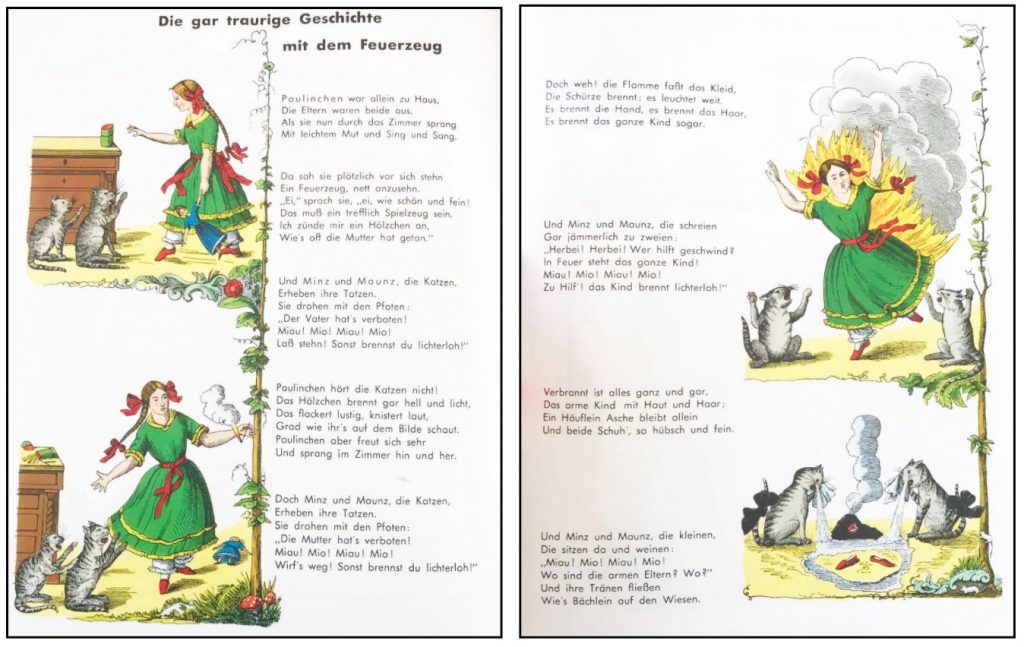
In Heinrich Hoffmann's “The Story with the Lighter” (1987), a double page can be evidenced that conveys a specific message to the child. By using the literary device of personification, Hoffmann brings to life two cats that try to warn the child about the danger of using a lighter. Undoubtedly, the visual communication that the young reader perceives in these pages is shocking, since punishment of children, especially physical punishment, is not morally acceptable today.
With the passing of time, children's lives have undergone several changes, which has led the communicative role of the picture book to take a radical turn, “unlike the traditional picture book, in which images enhanced, decorated and amplified, in today's picture book the visual text assumes almost all the narrative responsibility” (Salisbury and Styles, 2012, p.7). This quality is what makes the picture book an ideal instrument within current communication, since nowadays children and adolescents are increasingly visual, where even an icon can represent feelings, as is present in the use of emoticons when sending a text message via cell phone.
Authors Maria Nikolajeva and Carole Scott, in their book How Picturebooks Works (2006), consider the process of reading a picture book as a hermeneutic cycle, which starts from looking at the picture book as a whole, proceeding to the details and returning to the whole. This hermeneutic cycle creates understanding and deeper interpretation each time the picture book is read. “Presumably, children know this intuitively when they demand to have the same book read aloud to them over and over again” (Nikolajeva and Scott, 2006, p. 2), young readers with their ability to imagine and interpret, can appreciate the small details of the illustrations and interpret the text more deeply, the authors believe that adults often look at illustrations as mere decorative tools.
Likewise, the author Gloria Lapeña (2017), defines the illustrated album as an instrument of socialization, due to its inescapably referential character, both words and images are offering a certain vision of the world, transmitting a series of imaginaries that the reader collects and uses to explain reality (Lapeña, 2017, p. 192).
For this reason, it is not surprising that book-albums are present in the lives of children at an early age, becoming one of the first learning resources, becoming “a formative element of the first order at two levels: literary and linguistic education, through words, and artistic education, through images” (Fernández, J, 2015, p.116).
Once it is determined that the relationship between text and image is a characteristic aspect of the picture book and what contributes to generate interaction with children, the following question arises: Is the relationship between text and image only complementary? The answer is no, it is a constant game between changes of perspectives, this leads it to become a useful tool for the young reader, since through the images he can understand the story, “not yet knowing how to read, the young child endlessly interrogates the illustrations of the books and learns very soon how to decipher them” (Turin, 1995 cited in Hidalgo et al, s.f, p.100).
As can be seen, the album book is a fascinating means of interaction, its colorful pages, when interpreted by children, awaken their imagination and intelligence, making them gradually understand new topics.
References
Fernández, J. (2015). The illustrated album as an agent of literary artistic education and gender. El caso de mamá, by Mariana Ruíz Johnson. Spain: Universitat Jaume I. Institut Universitari d’ Estudis Feministes i de Gènere. Retrieved from:
http://repositori.uji.es/xmlui/handle/10234/141768
Hidalgo Rodríguez, M. C. (2015). Multiculturalism and social exclusion in illustrated albums: method of analysis. Venezuela: Revista Opción.
Hoffmann, H (writer, illustrator) (1987). Pedro Melenas y compañía, translated by Victor Canicio. Madrid: Impedimenta
Lapeña, G (2017). Illustrating, Narrating and Walking. The City as Archaeological Footprint and as Writing of Memory (Doctoral Thesis). University of Murcia, Murcia.
Nikolajeva, M. and Scott, C. (2006). How picturebooks work. United Kingdom: Routledge
Salisbury, M and Styles, M (2012). The art of illustrating children's books concept and practice of storytelling. Spain: BLUME