
By Irene Vélez Froment
How did the pandemic affect politics? More concisely: what was the effect of Covid-19 on the popularity of politicians? By politicians we mean the heads of state who have been in power since March 2020; and by popularity we mean the level of acceptance of their image and that of their government. To analyze the immediate effects, we will use as a starting point the analysis made by The Economist:
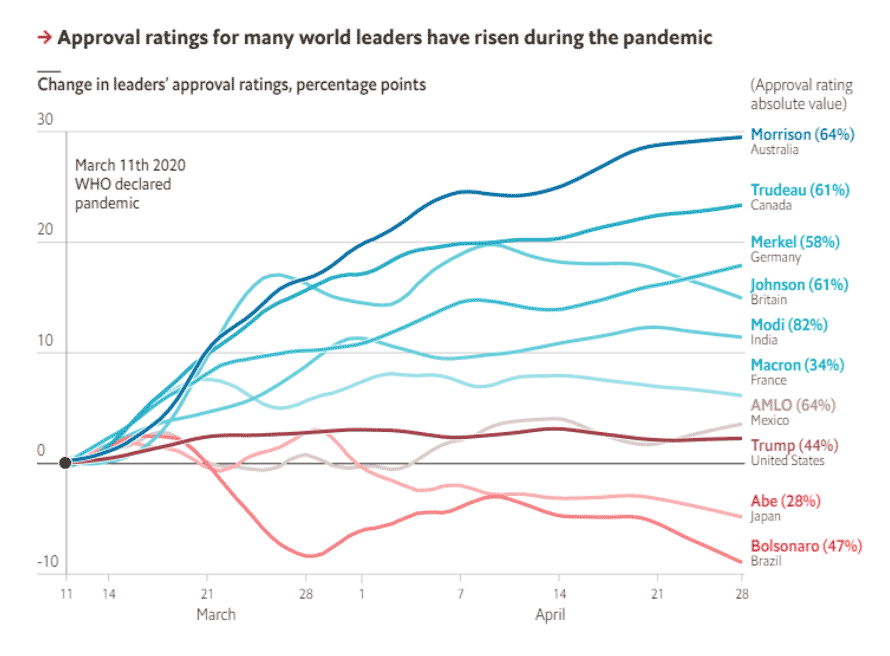
The above image measures the approval rating of: Morrison (Australia), Trudeau (Canada), Merkel (Germany), Johnson (United Kingdom), Modi (India) , Macron (France), Lopez Obrador (Mexico), Trump (United States), Abe (Japan) and Bolsonaro (Brazil), from March 2020 to the end of April 2020. Those ranked in the first places, had an atypical increase. Increasing approval by more than 30 percentage points is what every politician wants to see in their polls; those who actively participate in politics will understand the work involved in raising a point of acceptance from the government: months of work, boosting the country's economy, staying away from scandals, among other issues. Growing like foam is not a constant.
In fact it is so unusual that in the field of political science this is a phenomenon with a name and surname: Rally ‘round the flag effect. John Mueller, an American political analyst, used this term for the first time in 1970. He suggests that in crisis situations, especially in international conflicts or when there is an enemy to “blame”, the population closes ranks around its flag (embodied in the leader) seeking the security provided by the idea of the union of all as one. The classic (and therefore dramatic) example provided by history is George W. Bush and the increase in his approval ratings after September 11, 2001. His levels went from 50% to 90% in a single day. The explanation for this phenomenon is profoundly social and unfolds in the following scenario: first, the country has been attacked by an “external agent” that has significantly shaken the population. In the face of the instability and uncertainty generated by the shock, the population, Mueller assures, looks to the Head of State for stability and hope. In other words, to see that the rudder is being steered during the storm: the stronger the waves, the more a captain is needed; and the collective belief in his capacity to lead us to a safe harbor. Conclusion: we are facing an act of faith, a product of the need to believe that the lifeboat still has air.
The phenomenon was repeated in the initial context of the pandemic. The Economist's analysis shows us three behaviors: (i) the majority had an upturn in the first 5 to 10 days of the pandemic. In this category are those who managed to maintain that momentum and those who, on the contrary, after the fourth week saw their curve flatten; and (ii) those who after the first week saw their image associated with rejection. There is one exception and that is Donald Trump; his line (at least in the period studied) remains constant: it does not have sharp peaks of approval and disapproval. This behavior can be understood as a consequence of social polarization in the United States of America: the act moved to third place. From the outset, approximately 50% of the population will support him, and the other 50% will end up disapproving of his administration, no matter what it is.
What is missing from the analysis is the sustainability of these numbers (especially the popularity peak) over time. It is in this scenario that Angela Merkel rose in one month by almost 20 percentage points; however, in one year the political coalition is at its lowest point, close to losing in the next election. What does this behavior of the theory teach us? That the effect of “the flag” can fade and the initial euphoria is short-lived, especially if the perspective of time allows us to evaluate the results based on the decisions made by the captain.
The following graph allows us to establish the trend in government approval, as it covers results from February through July 2020. Australia (Morrison) was maintained compared to the start of the pandemic with 90% of approval.
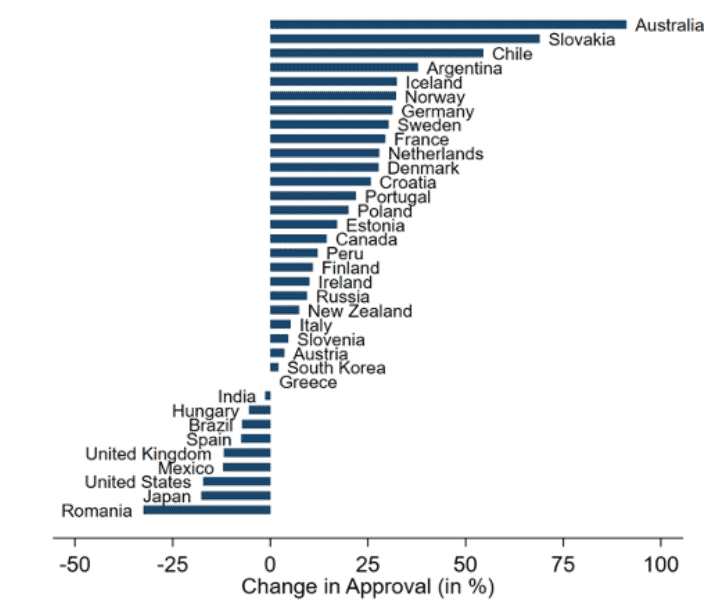
Why are some maintained and others see their approval in free fall? The evidence concludes that: a) Governments are punished in terms of political approval when the number of infections accelerated. However, this conclusion is only valid for governments that did not impose strict measures (such as Brazil or the US); and b) Approval rates in 2020 did not react to high frequency measures of economic activity. This suggests that flexible anti-pandemic policies were politically costly.
So governments that placed more importance on health outcomes compared to short-term economic outcomes gained political support. This effect increased over time.
However, the real results will be seen once the pandemic is over. After analyzing: vaccination policy, economic reactivation, effectiveness and transparency in the processes. At that time we will be able to compare who reached the goal (and in what state) and who fell by the wayside.
References
Eichenbaum, M, S Rebelo and M Trabant (2020), “The trade-off between economic and health outcomes of the COVID-19 epidemic”, VoxEU.org.
Herrera, H, G Ordoñez and C Trebesch (2020), Rallying round the flag.
Covid-19 has given most world leaders a temporary rise in popularity, The Economist
Giommoni, T and G Loumeau (2020), “Lockdown and voting behavior: A natural experiment on postponed elections during the COVID-19 pandemic”, Covid Economics 41:69-99.